I wrote this piece during my internship with Thurston County Commissioner Rachel Grant
#
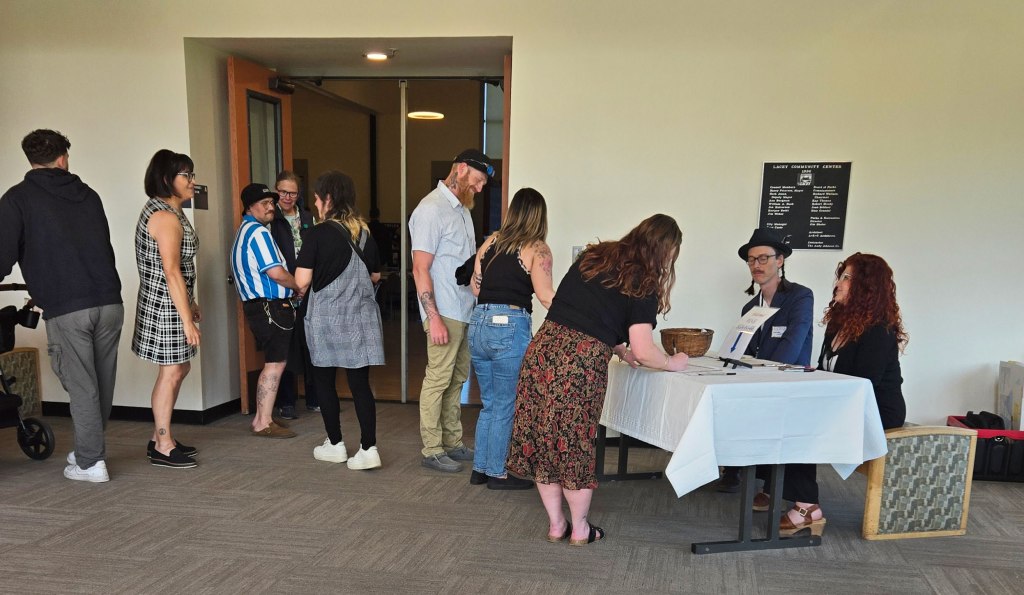
As they arrived the Excel spreadsheet came alive:
Angie from Capitol Recovery Center
Jason from Thurston Mason Behavioral Health Organization (TMBHO)
Hana from Hope and Healing Clinic
Shelly from Family Education and Support Center (FESS)
I checked them in at the welcome table. Some smiling, some tired from a long day, all very nice. A blip of excitement when someone signed in from Seamar Health Centers (they had been a bear to get ahold of in our outreach efforts).
Early on, a fellow came and I felt a frisson of recognition, though I’d never met him before. He carried a very full backpack with a first aid bag dangling off the back. His Providence-branded shirt read Street Medicine on the back. On the front, it read Jason. I realized he was a Providence Street Medicine team member I’d been playing email tag with, in efforts to set up a stakeholder interview.
I said hello, and at first he seemed shy, his eye contact wavered. Then we figured out how we knew of each other and he began talking about his work. (I also felt the same-same feeling of neurodivergence meeting neurodivergence).
Jason is a military veteran, a medic, now trained as social worker and street outreach worker. He walks the streets of Olympia, visits the encampments. “I meet people where they’re at,” he said. “I’ll provide medical care in a park.”
I asked him if he knew the other street outreach teams and he nodded and said, “I have their number and they have mine. We talk all the time.” He told me the lengths he’d go to help someone. Connecting people to therapy, to substance use treatment (“sometimes you only have a short window to help someone.”) Workers like Jason will drive people to appointments, to shelters, to the ER. They’ll pick people up from jail.
All without judgment.
Many of these people are peers, they have what is termed euphemistically “lived experience,” which can mean bouts of addiction, mental health challenges, homelessness, incarceration. Their life experience provides a trailhead to understanding the people they work with. Understanding clearly underpins their nonjudgment and compassion. But it doesn’t quite explain their dedication, their relentlessness.
Keith was there too, the prototypical outreach worker. Keith has lived experience of incarceration and homelessness. Now he works for, of all people, the Olympia Police Department, as a civilian outreach worker for the Familiar Faces program. He works with chronic and high needs unhoused people, the people who have been on the street long enough that the cops, the EMTs, and the ERs all know them by name.
I heard a beautiful podcast about the importance of awe, a while back. Researcher Dacher Keltner talked about what elicits the most awe in people. I guessed nature. The correct answer is other people (nature is second place).
There’s something about Jason and Keith and the people I have met on the frontlines of this thing. This tattered, torn, social safety net in this most unsocial of countries. As headlines describe the systematic vandalism and destruction of what few services we do offer (school lunches, medicaid, HEAD start, and on and on), these people keep going to work.
I often feel awe in these spaces, meeting these people. I’m struck by their quiet competence, their care, their compassion. The matter-of-factness of a street medic describing saving a life. A security guard at an addiction clinic recounting an encounter with an out of control patient (“he came back the next day and apologized. And I said, ‘It’s all good, I’ve been there.’’’)
Many of these workers have had hard lives. Many of them have been very ill-treated by society (by us). In so many ways, be it a prison, or a street encampment, we have thrown these people away.
But somehow, some of them survive, and return in service. It astounds me. After all they’ve been through, why do they give back? Why do they go back into the belly of the beast, to the place of their own wounding?
The trauma researcher Judith Miller talks about the survivor’s mission. The mission typically emerges several steps into a survivor’s healing journey. It is by no means a given. To get there, the trauma survivor must survive their traumatic experience, and then they must survive the gauntlet of downstream consequences: Mental health challenges like PTSD, addiction, suicide, incarceration, cycles of abuse and harm.
And perhaps their body has survived the gauntlet (for we are resilient creatures), but what of their heart? Their soul?
How many come back bitter, angry, violent towards themselves, or towards others?
How many come back with so much grief they can’t even see it (for as trauma expert Gabor Maté puts it, “all trauma work is grief work.”)
How many get ‘lost in the water,’ lost to addiction, in the words of First Nations grief elder Martín Prechtel?
Trauma can crush a soul, make it coalblack and diamondhard. It is these poor, crushed beings who become the bad actors in our society, great and small. They enact the trauma in our ecosystem on themselves, on others. They organize and do so politically, systemically, institutionally. There are entire government edifices shaped this way, political parties, nation states, cataclysmic historical events. Things happening right now.
Some of these survivors, though, they don’t drown in the waters. They don’t burn up in hatred and destruction. They get up, wounds and all, and they turn around, and they extend a hand to the person behind them.
I can’t account for this with logic, with psychology, with systems theory.
There is a certain something I’ve been tracking in all this, an X factor. People in these spaces name it. Sometimes they say compassion, sometimes they say god, sometimes they say love, sometimes they say collective liberation.
It is a kind of alchemy, born of mundane ingredients but catalyzed by magic. In grief spaces we say, ‘From the wound, the gift.’
Somehow. Somehow these people reach back to their wounding and bring back an offering. From their experiences of suffering they bring an unshakeable determination to make meaning of what happened to them.
I’ve never met such resolute people, as those who have committed to service after “lived experience.”
And what is meaningful, for so many who have known deep pain? That others may be lifted from similar pain, that people and institutions may be shepherded towards healing, that, in the words of Thurston County Commissioner Rachel Grant, “nobody else falls through the cracks.”
The survivor’s mission: To be part of the healing of this world. Mister Rogers said it best:
“No matter what our particular job, especially in our world today, we all are called to be Tikkun Olam—repairers of creation. Thank you for whatever you do, wherever you are, to bring joy, and light, and hope, and faith, and pardon and love to your neighborhood and to yourself.”
–Fred Rogers, 2001
Sometimes I despair at the systems of oppression, those towering monoliths that crush us to earth. Surely they are too big. They consume us. And so many of us, lost in the traumas of oppression, march in lockstep–we become those systems. It is the ouroboros of trauma, the cycles of violence, cycling throughout the human world, across generations, and deep into our biome.
But if there are systems of oppression, there is another blooming fractal, the systems of repair. Where there is suffering, there is the possibility of suffering-with, also known as compassion. Where there is wounding, there is the possibility of healing. Where there is cruelty, there is the possibility of kindness.
Mister Rogers also said, in scary times, “look for the helpers.” Look at Keith, look at Jason. Look at Hana. Look at Stephanie. Roxanne. Lara. Jacob. Buck. Karen. Jennifer. Kewee. Talib. Zoey. Eirik. Dana. Gretchen. Tara. Neil. Briana. Ahlay. Jordan. Aaron…
Look at us helping each other.
Is it possible there’s a bigger system out there, than those wheels of oppression? Something quieter. Humming along. Passing between us. Resolute.
Love
Noun
The will to extend one’s self to nurture one’s own or another’s spiritual growth.
M. Scott Peck and Erich Fromm, via bell hooks, All About Love
 Evan Wagoner-Lynch