You Belong Here™
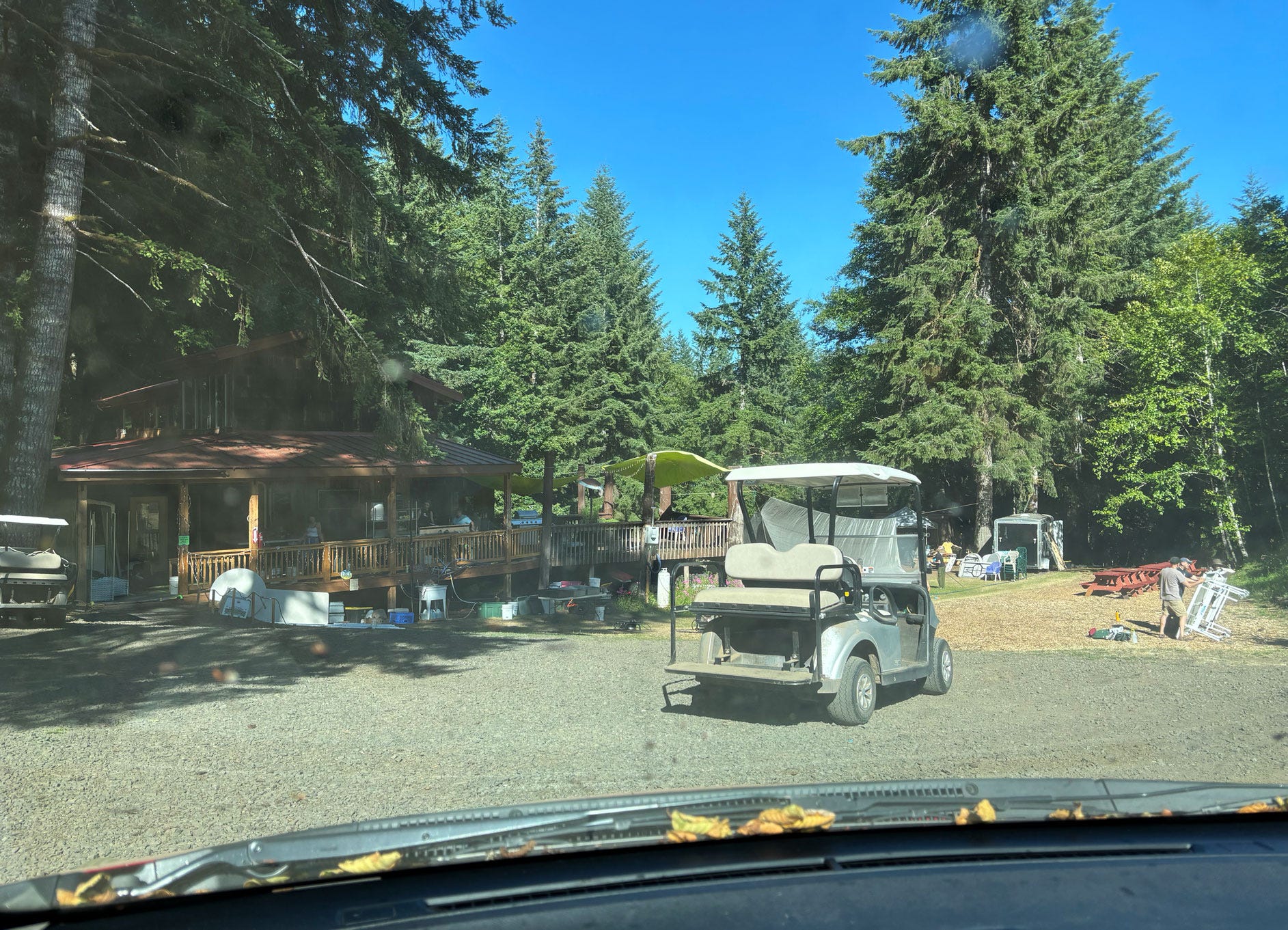
For eight days in late June and early July I lived in a village. A temporary village nestled in the foothills of the Oregon coastal range. For eight days I was never alone (except for two walks in the woods). I ate in big communal meals, I circled up for morning opening sessions, workshops, song circles, even a conflict circle.
I was in Oregon for Liberation Lab, an activism retreat, and Cascadia Songrise, a community singing festival. When Songrise ended, it was time to go.
It was only as I pulled away, down that long gravel drive, down the mountain, to the road, to the reality of this fractured place, that I noticed what village had done to me.
The thrum of my anxiety disorder, my PTSD, went to sleep so quietly I didn’t feel its passing. I felt it stir in me as I left these people, this temporary village on the mountainside.
I saw my first homeless person on the side of the road. If I were in village, I would have stopped. I would know his name, I would ask, how can I help?
I drove on.
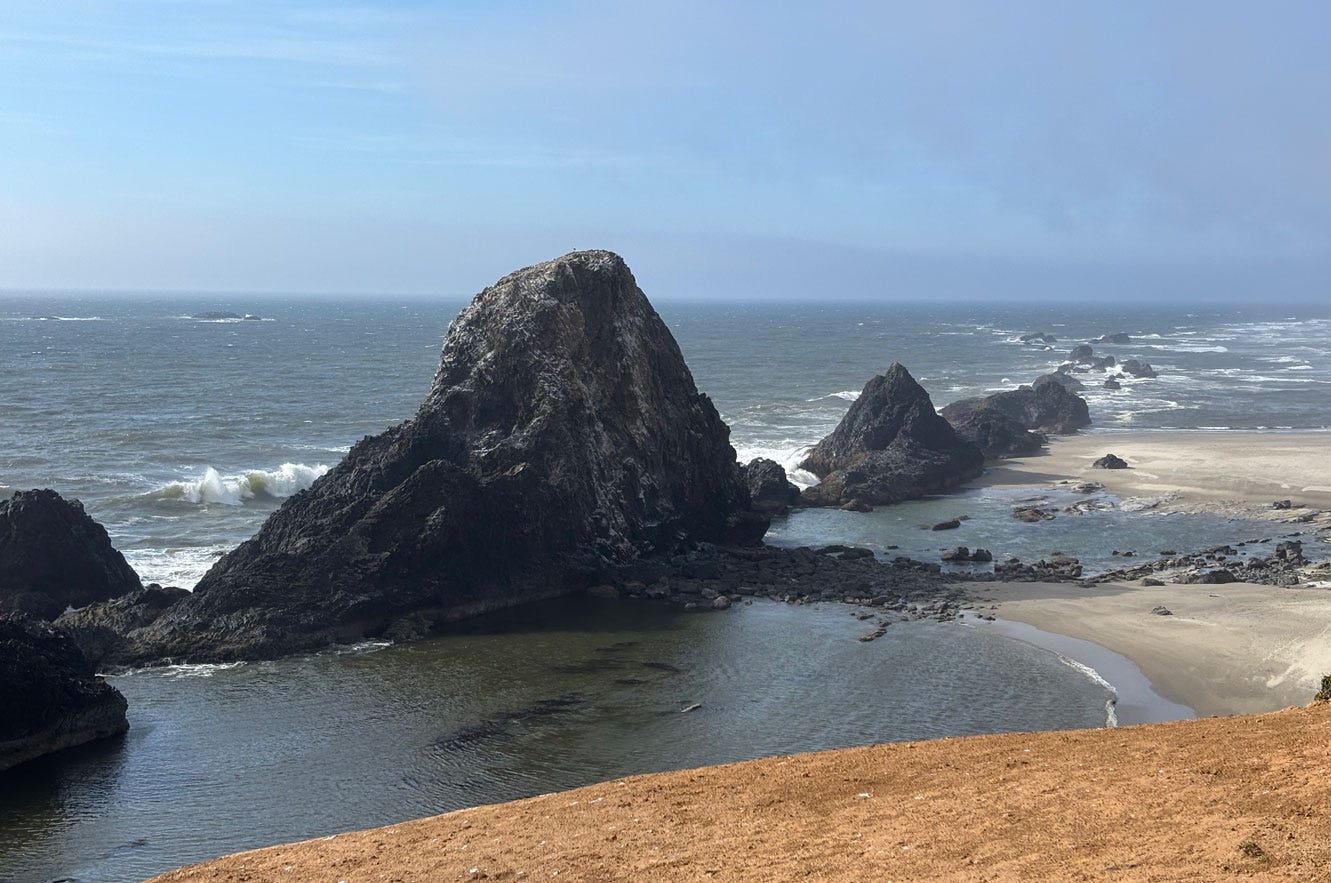
On the coastal highway I was hit both by the majesty of the coast, the surf, the brisk breath of fog, the towering rock formations, and the ugliness of the human world. The tourist traps, the McDonald’s, the resorts, the sprawling towns that felt anonymous, inhumane, scattered.
On a rural highway a sign loomed cheerily: YOU BELONG HERE. My spirit lifted, a message from our ancestors! Then the punchline, the fine print, the name of a commercial real estate business.
The profanity of our disconnect, the sacred joke of it. What could I do but laugh?
I don’t belong here. I’m not sure anyone does. To a coastal town named after a white colonist. To the rolling hills ravaged by clearcuts. To the roadside Indian reservation.
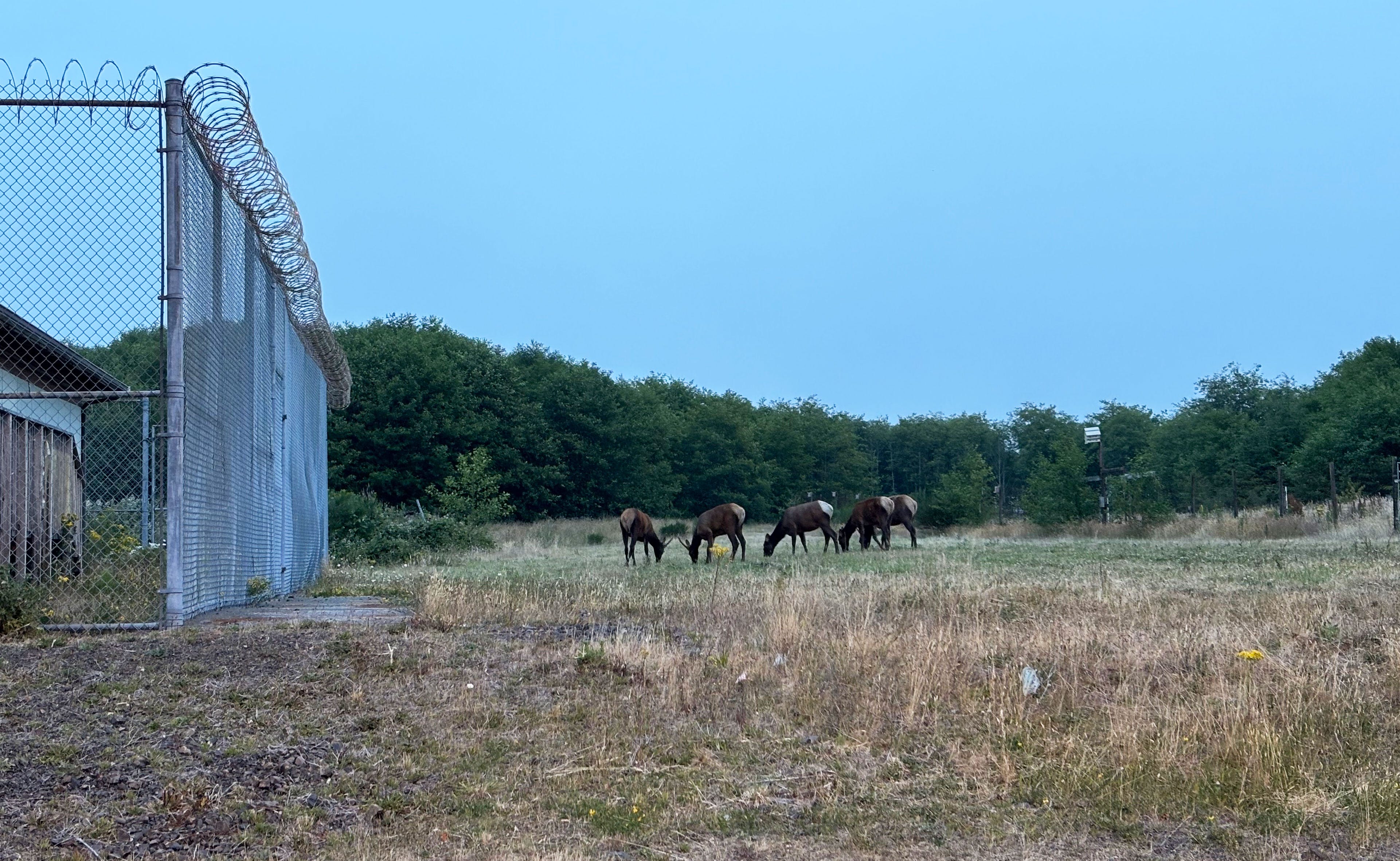
And yet, in my lostness, my disconnection, I do belong. I am the elk grazing at the state prison, the solitary tree standing after the clearcut. There’s a rightness to my disconnect, a naturalness even. My distress marks me as of this place. Because this place, too, is in distress.
Emerging
I continue to reach far and wide in my quest to serve the rebirth of community. Most recently, to Portugal, where I have been approved for a workshop at the Tamera eco village. Financial aid will not cover this study abroad, so it feels risky.
And I’m chasing a bigger vision, which is to talk to stakeholders in Europe about developing song and grief culture there (if you know anyone in Northern Europe who might be interested, let me know).
I see two roads ahead: One of financial risk aversion, and another of trust. One I’ve taken many times, the other, rarely.
This weekend I’ve set the goal of buying the tickets and sending the workshop fee to Tamera. If you or anyone you know might be interested in supporting this work, please join my Patreon.
I want to thank my Patreon supporters, who have been my main source of financial support for the past few years. I don’t know how I would have gotten to this point without their help.
After the village experience (more on that in a moment), I rushed back to Washington for the opportunity to attend an Evergreen class inside Stafford Creek Correctional Center. As in my past encounters in the prison system, I was deeply moved and inspired by the people I met inside. I wrote a piece about it on my Patreon (free to view).
And now, for a story about a baby I know.
Village Baby
I. Kiki
Strange to think I once disliked kids. I disliked kids when I was kid. The noise, the emotions, the chaos.
Strange to think as Kiki climbs on top of me and gleefully punches me in the face. Her balled fists the size of meatballs.
Kiki’s mom is nowhere to be seen. We are on the edge of a large circular tent, an elegant structure held aloft by slender raw wood poles. An intoxicating African polyrhythm, pounded on African drums, animates the space. Some 100 or so humans dance and call and cry. We are in ritual.
Kiki is a special baby, a rare creature in our fractured world: A village baby.
She is raised by a single mom and by a network of other adults on an intentional community and urban farm.
I’m always astonished when her mother steps away, and Kiki watches her go, saying quizzically, “Momma?” But then turns to me or some other nearby human and continues about her babying.
I am the quintessential clueless uncle. One of Kiki’s aunties had to remind me how to hold the bottle. I’m not much use when things fall apart. That’s when I hand her off.
But in this moment as the ritual unfolds, Kiki is content to cuddle and hammer me, and I am happy to be that person for her.
An idea bubbles up, based on something I read recently.
In Tribe, Sebastian Junger talks about how babies in village culture learn to regulate to village life—singing, dancing, adults talking late into the night. Rather than regulating to modern life—sleeping alone, white noise machines, mechanical rocking cradles, lifeless stuffies.
And there’s another piece, something Kiki’s mother told me. For Kiki’s mom is a grief ritual facilitator. And Kiki has attended grief rituals both in utero and in the first months of her life. Dozing as people wailed and cried. Strapped to her mom, content but a bit perplexed as it rained at the altar, the tears of her mother dripping down on her.
So this idea bubbles up: I want Kiki to experience this ritual.
I let it rest for a bit. Is it wise to alter this pleasant status quo, to rock Kiki’s boat?
But the drums call. The dancers call. I scoop her up and nest her on my bony hip. We sashay into the circle dance.
From my high vantage, Kiki takes in the human tumult, her eyes owl-like, black pools in the firelight. Kiki and I join the merry-go-round of dancers, we orbit the fire pit. Then I take her to the drums, to the drummers. Mindful of her little ears, I don’t linger, but I want her to feel and experience her birthright.
At times, she seems to dance in my arms. At others, she mutely takes it in.
And then finally, it happens. Her eyes begin to droop. She nestles her head in my neck and begins to fall asleep. Around her the chorus of drums, the cries of people in ecstasy and grief, the pounding of feet on grass, the crack of glowing wood, the scent of smoke and sweat.
I continue to orbit and Kiki’s mom emerges from the darkness. Kiki stirs and makes the international gesture for pick-me-up. And Kiki’s mom smiles and takes her daughter in her arms. And then after a moment of connection, to my everlasting joy, Kiki fixes her owl’s stare back on me and stretches out her arms. My whole being sings to be that for her, one of her uncles, part of her village.
I am reminded of an oft-repeated tale about the West African grief ritualist Sobonfu Somé, who recounted being asked, when she was very little, who her mother was. And the story goes, that she guessed wrong. Imagine that: So many caregivers that a child can’t keep track.
And the core longing named by grief expert Francis Weller, that we all expected to be greeted by forty pairs of eyes when we were born on this earth.
I know that grief well. It feels like a shard of ice in my heart.
This night, with my bare feet on the ground, and a village baby on my hip, the wrongness of this world rights a little, and the wound thaws a bit, as saltwater pouring from my eyes.
II. Village Daddy
Something deeper stirs, in my blissful days with Kiki the baby. The first time that someone asks me, Is that your little one? I am taken aback. No, I say, smiling, almost pained. As if we should all know how unlikely this is.
For most of my life I was dead set against being a parent. There was a deep knowing in me that I would not and could not be a parent. I recall researching vasectomies in my early 20s. And then hearing that urologists would laugh a young man out of the office. So I never tried.
It wasn’t until I finally grappled with my trauma that the length and breadth of my antipathy toward being a parent became clear.
I realized my inability to connect with children was learned. It was the intergenerational wound that was visited upon me by my own parents, who experienced that same disconnection with their parents, and on and on.
I remember deep in a grief ritual hearing a small but clear voice that stunned me. I want to be a daddy, it said.
Behind those words, an ocean of grief waiting to burst through the breakwaters, the dams, the gates.
I had no idea this longing was in me. Cloaked by the 20something’s impatience toward children, the 30somethings general skepticism of childrearing in Late Capitalism, all those layers of cynicism. Underneath, a shattered heart. And a stillsmall voice.
I want to be a daddy.
And so, when Kiki wrapped her little hand around my finger, when people looked at us and smiled—Is that your little one? Waves of grief breached my defenses.
And in the clarifying waters of grief, a stark realization.
I can be a parent—In the village. I can be one of the forty pairs of eyes.
And I cannot be a parent in the fever dream that is the nuclear family.
And the truth is, none of us can, not really. It’s an impossible task, for one, or two, or maybe four or six adults to approximate a village.
Another Sobonfu quote:
It doesn’t take a village to raise a child, it takes a village to keep the parents sane.
It was never meant to be this way. And the nuclear family, the suburban house, these are unprecedented in the human story. Since time immemorial we raised children together. Primary caregiver, that term of art in Western developmental psychology, is meaningless to our ancestors.
The village baby is raised by the village. The village baby is raised by the culture, by the ancestors, by the land, by nature, by spirit.
Now that I see, I cannot unsee the patent absurdity of how we are trying to raise children. How I was raised. How my parents were raised.
It’s a rigged game. Of course my mother and father fell short. They were never meant to succeed.
Where were my 40 pairs of eyes? Where was my land? Where was my earth? Where was spirit? Instead, just one fulltime caregiver-mother. And one much exhausted and beleaguered breadwinner-father.
I believe the present epidemic of attachment trauma is largely a modern invention. Perhaps as new as the clock or the steam engine. Certainly the term ‘loneliness’ took off in the English language in the 1800s, precisely as industrialization took off.
And I think, as is so often the case, our Western frame is much too small. Our lens is distorted through our radically individualist worldview. We see individuals suffering from addiction, or depression, or loneliness. We fail to see a species of social animal divorced from its socialness, its naturalness, the interconnectedness that is its truth and its birthright.
As Otto Scharmer of the Presencing Institute likes to say, we need to shift from egosystem to ecosystem.
The soil conditions for human thriving are not present. Where is the rich network of connection that we emerged from throughout those countless generations? Is it possible that the distress in our environment is but a mirror of the distress inside our own bodies, as we have lost our way?
We are sick because our biome is sick. The biome is sick because we are sick. Because, in truth, there is no meaningful separation between the two.
I pray that we wake up.
Each morning I go for my walk and I sing and I pray for village.
I cannot live another 40 years of this suburban individualist nightmare. And I look around me and I see that I am not alone. I see us crying out in so many ways. Sometimes our cries sound like fentanyl, sometimes like an AR-15 rifle, a Fox News tirade.
But what I really hear is that we want to come home. We’ve been out in the dark these many generations and we want to come home. I want that for us. I pray that we get there. Or at least, that we’re walking that way.
My little friend, Kiki the village baby, is a little light in the darkness. I pray that she walks upright in her adulthood, secure in her place on this earth. And I pray that her children don’t know loneliness, not like we do.
May it be so.
Links
Today I was grabbed by Brian Stout’s remembrance of two powerful people who recently passed, Joanna Macy and Andrea Gibson. Avatars of grief and gratitude.
 Evan Wagoner-Lynch