This piece is part of an ongoing series of journals from my work at Stafford Creek Correctional Center through the Evergreen Prison Education Program.
March 2026
The altar was ugly: Four lonely sprigs of cedar surrounding a dingy plastic bowl. A paltry pint of water in the bowl. All of it sitting on the institutional linoleum floor. Harsh fluorescents overhead. In the background, the occasional terse grumble of announcements over the public address system.
We have been talking about ritual and grief for 30 minutes. I’ve shared a bit of what I know. They have shared back:
It is not possible to cry in prison
How do we grieve in a traumatic institution?
There’s so much we have to bury to get through the day
There’s so much grief in here
Clock time, as always, does violence to ritual, as it does to community. We are running out of time.
I stop explaining and I start invoking.
I greet and thank the cedar I have carried from Evergreen to the prison. The same cedar that the guard eyed skeptically at security. Why are you bringing plants here, she asked.
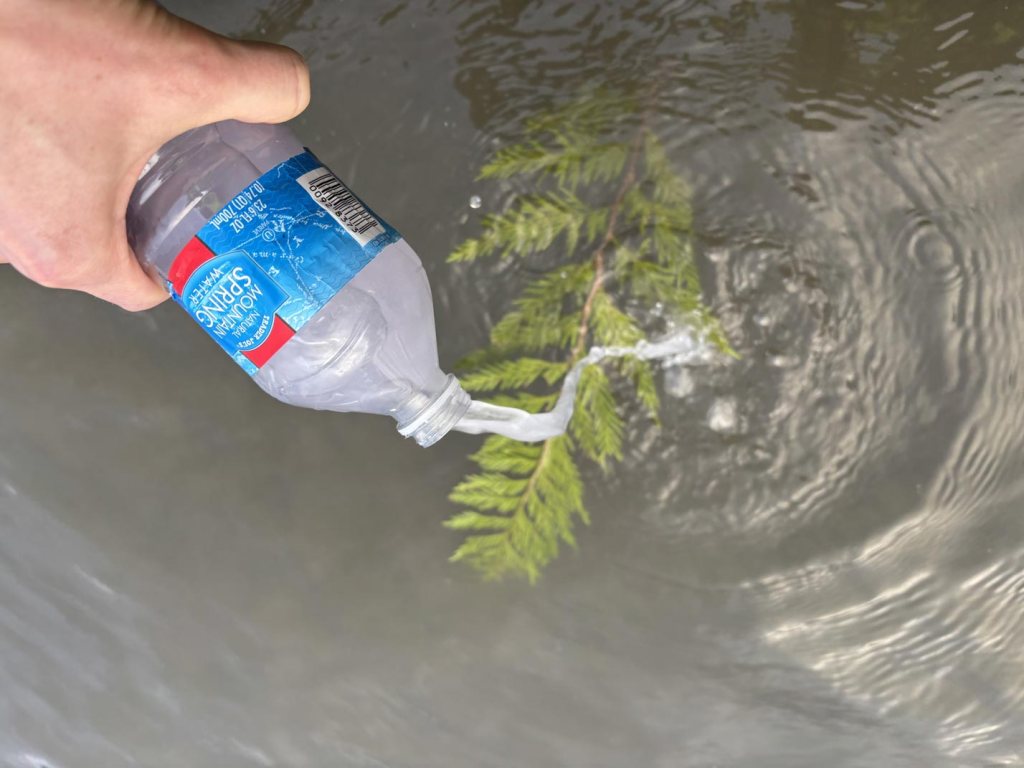
I greet and thank the waters, the living waters of the Salish Sea that I have brought into the prison in a reused Trader Joe’s water bottle.
I thank the land. I thank the people who have stewarded this land since time immemorial. I thank my teachers.
And then I turn it around to the participants, the incarcerated students, and I ask them if they would like to invoke anyone or anything.
Silence.
I wonder in this moment: Are they with me? Is this too much? Not enough? Am I full of shit? I’m sitting with 24 bullshit detectors, trauma survivors, people who scan for safety 24-7.
Who am I to do this?
My professor leans in and says, We have about 10 minutes left. And I realize with a jolt that I have miscalculated the time remaining.
And so we dive into a simple ritual. I have provided each student with a sheet of water-soluble paper. I invite them to write down their griefs and place the notes in the bowl.
I tell them that I will be taking the water back out of the prison and to the sea, where I will return it.
Externally they are near impassive but I feel a ripple go through the room.
I begin to sing my favorite grief song:
You do not carry this all alone,
No, you do not carry this all alone,
This is way too big
For you to carry this on your own,
So, you do not carry this all alone
As I sing it for a second time, I hear the faintest chorus of voices joining me. The students place their papers in the bowl. I hear no wails and see no tears. No outward sign in their faces that anything is moving.
I do note, and reflect on later, the significance of the closed eyes and contemplative expressions of some of the students.
Later I also recall that nearly all of them wrote a note and placed it in the water.
And then we must close just a few minutes before Movement.
Movement is reminiscent of the classroom bell at school, but with the urgency of a police order (which essentially, it is).
I stop singing. I thank and release all who we invoked.
We have a minute for reflections.
A student speaks up and says, That was nice.
They begin to pack up.
And a student who I know as a truth speaker turns to me and I brace for bitter medicine.
But she says:
That was powerful. I liked the song the most. Then she went on, It’s good that there weren’t any fireworks. We can’t do that in here. But people were into it. We need this. Then she looked at me and said, You should come in here and run a program. Sponsor us so we can do this.
And I said, I’m working on it.
And the last of the students filed out. A few of them shook my hand, as they often do.
In the afternoon class, I had a couple conversations with students who were present for the ritual. To my surprise, I heard that they found the practice powerful. And I heard about their griefs, and how they have no outlets. How in a prison, crying or grieving marks you as a problem, both among the staff and the incarcerated people. How there is not one place for privacy in the whole institution.
I rode home with my professor. I was buzzing with the intensity of the day, and the vulnerability hangover of having run a grief ritual with such a hard-to-read group. Did it go well? Did I do good? (Underneath that, Am I good?)
We talked about how, in the context of a prison, in the context of such deeply impacted, traumatized, unfree bodies, that perhaps this was a success. That the quiet little ritual was perhaps the right ritual for the moment, and for the people present.
So different from what I do Outside, the raucous, tear-stained, window rattling expressions of communal grief we hold. Often landing in grateful puppy piles, former strangers now lovedrunk and praising life’s excruciating beauty.
Inside it was quiet. Still waters masking what was moving underneath. Unknowable expressions of grief silently dissolving in water. Only the sea will know. Not safe to share with us, yet.
No puppy piles of mutual care. Incarcerated people are forbidden from touching one another (and I am forbidden from touching them).
Back at Evergreen’s Olympia campus, another institution in the woods, but this one without gates, fences, and pepper spray. I open the car door and my professor says, I wanted to thank you for doing this.
I smiled and tried to take it in. Did I really do this? Was it good?
I deprecated a moment, and said—I wish the altar had been better. My teachers say, ‘spirit eats beauty.’ This was the ugliest altar I’ve ever made.
And she said, Yes, but the gesture was beautiful.
I thanked her and hauled my things to my car. The ugly bowl, the bottle of now cloudy water. The contraband cedar.
And when I closed the car door at last I wept. The weight of the day. And the beauty of the gesture.
Yes, we held a grief ritual in prison.
Yes, I’m the one that did it. This time, it came through me.
I wept and thanked my teachers, my ancestors.
I wept with gratitude for the opportunity to be medicine.
I wept with gratitude for the opportunity to be an entrepreneur for spirit.
I wept that I carried the medicine into the prison. I wept that some of that medicine was me.
And then I drove to the Evergreen woods. And walked down to the beach. And sang and wept and spoke to the water as I released it to the sea.
A strange gesture. A silly gesture. Me with my Trader Joe’s bottle and my boots, singing in the Squi-Aitl Inlet.
And the very essence of ritual. A human encounter with something bigger than us.
My teacher Malidoma Somé said that the visible part of the ritual, the human part, is just the ceremony. But the real work, the transformative work, the magic, happens on the other side, in the realm of spirits.
What is happening in prison is too big for any one of us to hold. We simply cannot carry it all alone.
It is my prayer that some grief, some pain held by the people in the prison is now held by the sea.
It is my prayer that ritual begins to heal us as a people.
It is my prayer that ritual reminds us how to be a people.
May it be so.
#
Song: Carry This All
By Ahlay Blakely
 Evan Wagoner-Lynch