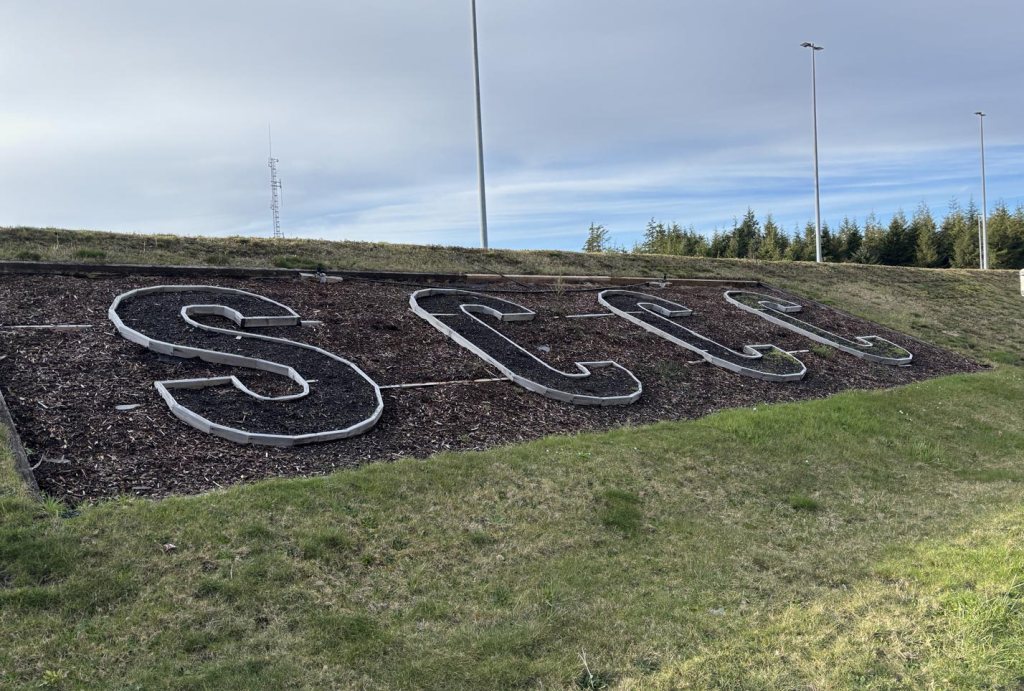
This piece is part of an ongoing series of journals from my work at Stafford Creek Correctional Center through the Evergreen Prison Education Program.
The first time I walked into a prison, after I overcame the somatic jolt of the place, I remember thinking, ‘We should be singing and grieving in here.’
Months later, I attended another prison education event, held for space reasons in the prison chapel. It was my first time in the chapel, a surprisingly airy and open space on the second floor of the education building. And I remember thinking, ‘we should be singing in here.’
Imagine, for a moment, that I did not think of this. That the idea of singing in prison is out there in the ether.
A funny thing happens though, when I speak in the language of ideas. Or put another way, when I speak in vision.
Last year I began talking to people about this idea. I spoke using the tools I had learned in the Changemakers Lab. I spoke in terms of problem and vision:
I see disconnection and rupture at every level of human relationship, from the self relationship, to the relationship to others, and the natural world. I see us coming together around reconnection, through traditional technologies of belonging like singing, storytelling, visioning, and grieving.
Problem and vision. It’s a powerful way to communicate, because it creates an instant bond with anyone who feels and sees similarly. And those people, those fellow travelers crop up in the strangest places.
I spoke to a Department of Corrections program coordinator who told me, ‘we need secular singing groups.’ And another staffer who said, ‘that sounds great, let’s get you set up as a volunteer.’
I spoke to Ahlay Blakely, a friend and traveling song and grief facilitator, who said, ‘I’ve been wanting to get into the prisons to sing for years, and I didn’t know how.’
I spoke to my faculty advisor Eirik, also the head of the Evergreen Prison Education Program, who said ‘How would it look for you to bring a song to our students.’
##
On a brisk Saturday in February, I accompanied an Evergreen psychology professor, Sfirah, into Stafford Creek Correctional Center. This time I was not a visitor, but a teaching assistant. First day on the job.
The incarcerated students filed in and took their seats in our circle of tables. I was pleased that we sat in circle, and that we started each class with a check-in. When it was my turn to check-in, I mentioned some of the singing I’ve been up to.
A while later, J., one of the more gregarious students, announced in front of the class, ‘So, Evan, you’re gonna sing for us?’ And I said yes.
But three hours goes by in a heartbeat in our class, and the opportunity to sing did not present itself before the students left.
Sfirah and I hustled out of the prison for lunch in Aberdeen–a jarring place change—and in the car she suggested I offer a song at the opening of our afternoon class.
##
Another round of screenings, x-rays, and gates, and we were back for afternoon class. After check-ins Sfirah announced to the class, ‘now Evan is going to lead us in a song.’
And I did what I have learned to do over the past year of running song circles.
I assured people they didn’t need to sing well, or at all. I told them that singing was originally about connection, not performance, or perfection.
I have learned in engaging with vulnerable groups to go slow, and come in the spirit not of knowing, rescuing, or fixing, but of curiosity. In bringing song to prison, I held the questions—Is this right for them? Will it be too much? What do they want?
So I moved slowly. I was prepared not to sing at all, but to sit together, quietly breathing.
I closed my eyes. I invited them to take a breath, and heard to my relief that collective in-breath. Then the sigh of exhale. Gradually I invited us to make sound. I heard muted sighs and groans. Then I invited us to hum, and sure enough, we hummed.
Then I began to sing:
I reach down, down, down, deep
And my heart soared to hear the voices rise in the room.
I reach down, down, down, deep
We drowned out the terse chatter of an announcement on the prison PA system.
Mother earth welcomes me
I dared open my eyes and to my astonishment and joy, I saw a room full of incarcerated students—no, I saw a room full of people doing what people do. Which is, to sing, with their eyes closed.
In this place of trauma and survival, in this place of hyper vigilance, they closed their eyes, tender as lambs, and they sang together.
Heaven felt near.
Mother earth welcomes me
###
We landed in a peaceable silence. The students shared:
That was so soothing.
I thought that was going to be weird, but it was really natural.
And then one of the quieter students spoke up. K., a striking man with the elegant features and musical accent of his home, in Africa.
That was beautiful, he said.
And a classmate said, K., sing to us in your language.
And he smiled and assented, and then he started in with a story.
He told us how, as a boy in Africa, he would go for walks with a beloved bull. And then he sang us the song he would sing to the bull.
It was haunting, and almost unbearably beautiful. The words and song of Africa reverberating joyously in the stern walls of that institution.
Afterwards, as we sighed in the presence of beauty, I had to tell them. I told them about the origin of the song we sang together, a song “caught” by Alilia Johnson, sister of touch and song activist Aaron Johnson of the potent Johnson family. The Johnsons sing in the gospel tradition of their African heritage. I let the students know that Aaron’s only request to me, when I share his family’s music, is to share it in the spirit in which it was created, which is: Liberation.
And so, we returned to our class, the subject of which was, Liberation Psychology.
 Evan Wagoner-Lynch