So much has happened since I last updated you.
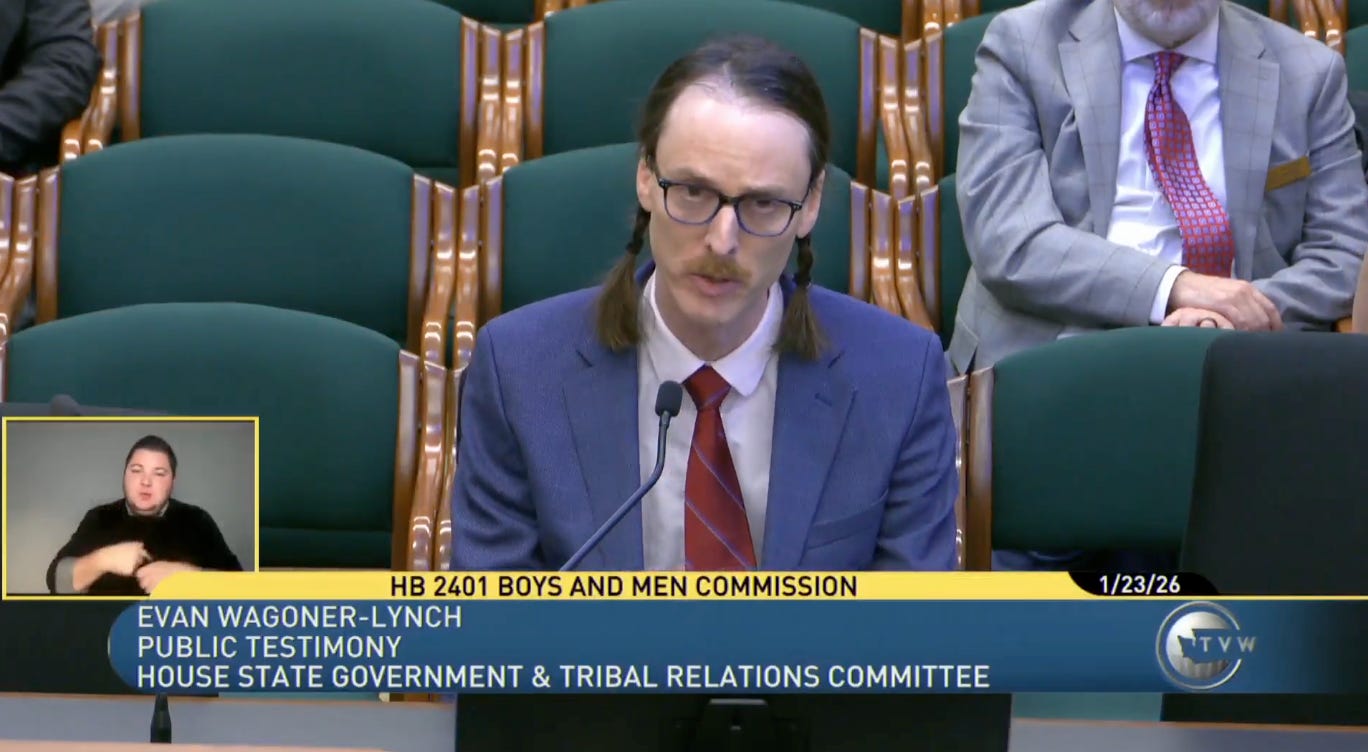
I could tell you about how I testified before the Washington State Legislature in support of the wellbeing of boys and men (and how, this time, we lost).
I could tell you about my new job: Program associate at the Evergreen Prison Education Program.
I could tell you how I brought community singing into a Washington State prison.
I could tell you about the song an incarcerated student shared, a song from his childhood in Africa, a song for his pet bull, a song from before the war, before he was a refugee, before he came to America, and got into terrible trouble, and we locked him behind high walls.
I can tell you how the walls fairly shook for the beauty of our singing.
I could tell you how I have been bringing cedar sprigs into the prison. And how, afterwards, I have taken the cedar to the grief rituals I have been holding in Olympia and Seattle. And how we cry over them and bless them.
I could tell you how I led three grief rituals this spring. And the quietest, simplest, and shortest was a small grief ritual I held in the prison. Nobody cried at that grief ritual, because crying is not safe. And nobody held one another, because holding is forbidden.
I could tell you about the personal vision workshop I held in prison, and how I had the wild idea to ask the students a visioning prompt from environmentalist Joanna Macy:
If you knew you could not fail, what would you do in service to life on Earth?
And how a bright-eyed man in prison khaki pulled me aside, his whole being radiating a need to get something through to me, and he said:
No one has ever asked me that.
And then he told me how as he grappled with the question, in his imagining, he saw himself in a forest. A place he hasn’t been in twenty years.
Imagine that. A simple question transporting a person out of prison. What else might be possible?
Ugly Altar, Beautiful Gesture
When it was my turn to share I took a breath. I twisted the talking stick in my hand, feeling its splintered surface. I looked to our grief altar, and saw one of my contributions. An ugly plastic food container with four sprigs of cedar in it.
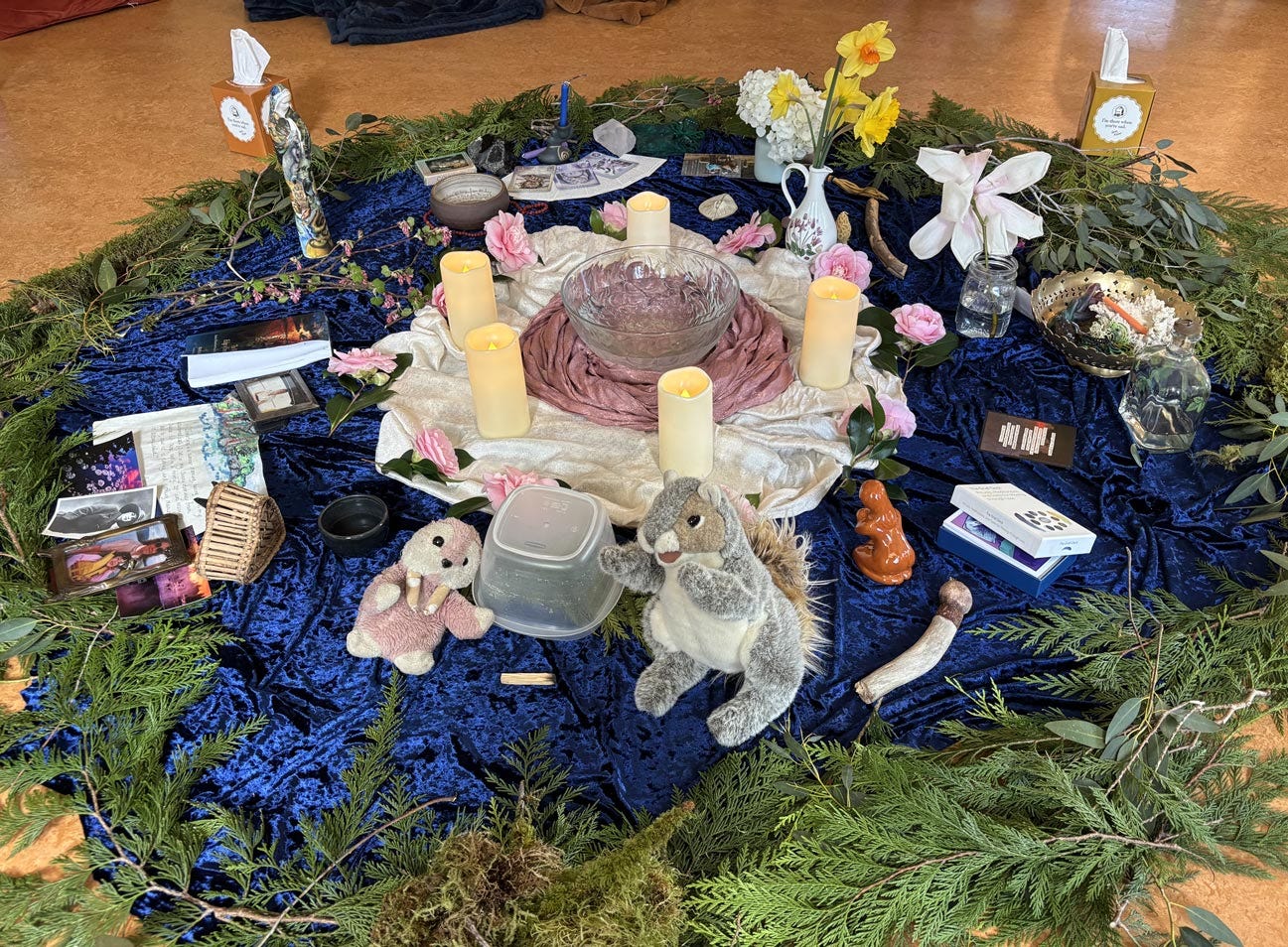
I picked it up, held it in my hands, and told the group a story.
I told them how I had carried this plastic basin, this cedar, and a Trader Joe’s water bottle filled with Salish Sea water into Stafford Creek Correctional Center.
I told them how the cedar almost didn’t make it through security. How the officer scowled and said, Why are you bringing plants in?
I told them how I held a small and simple grief ritual in the prison with a class of incarcerated students through my job at the Evergreen Prison Education Program.
I told them how the incarcerated students told me that they couldn’t cry inside the prison.
I told them how I wanted to hold these students but it is not allowed.
I described the little ritual. How I invited the students to write notes about grief on special water soluble paper. And how I invited them to place the notes in the basin of salt water as we sang.
And I told them how I brought the cedar and the salt water back out. How I returned the water, with its dissolved grief, to the Salish Sea.
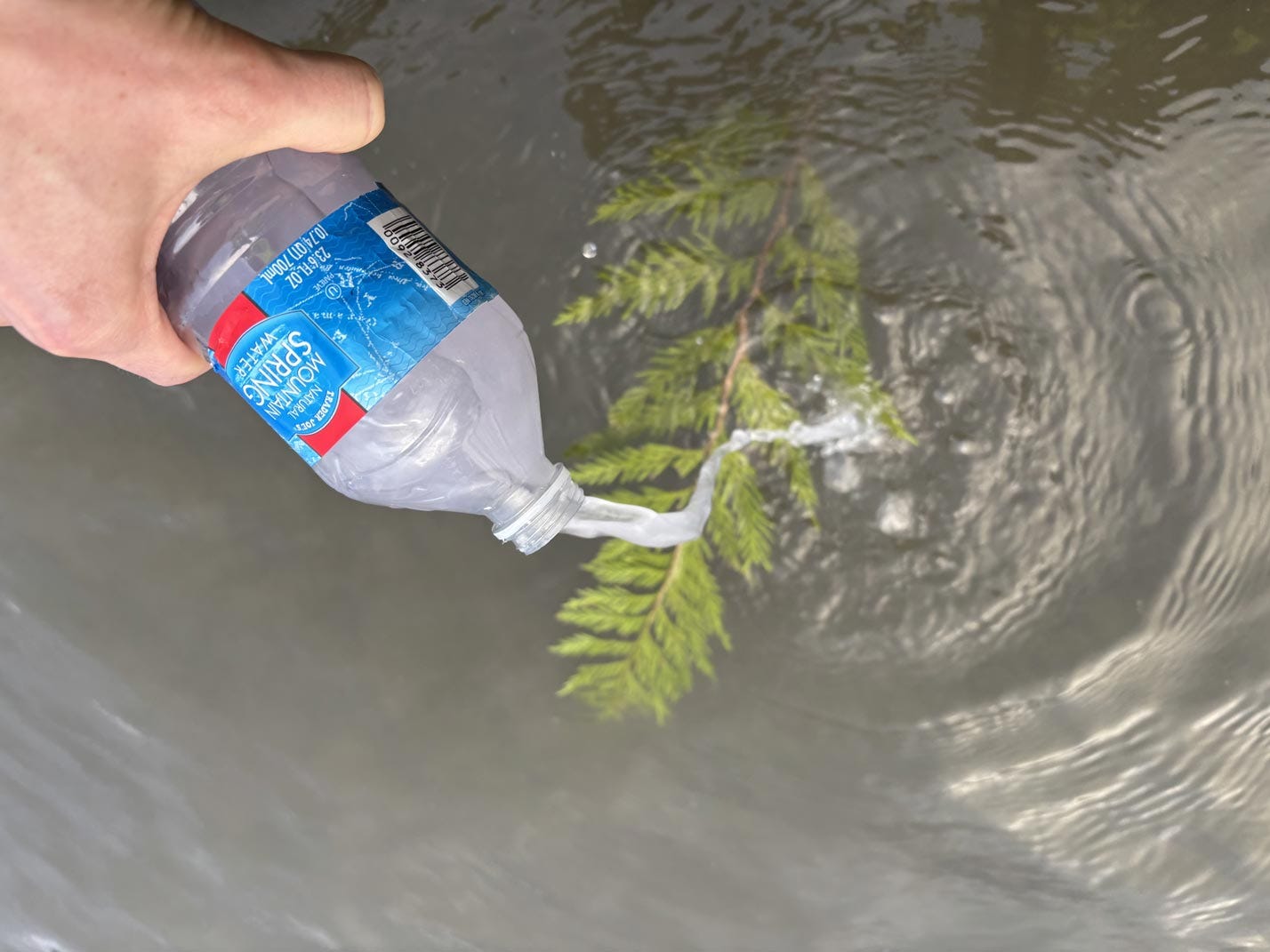
And then an idea bubbled up. I invited the participants of the Olympia Community Grief Ritual to take the Stafford Creek cedar and return it to nature.
I said, Find somewhere beautiful, somewhere free. And send me a photo.
And as we packed up at the end of the ritual, unseen participants grabbed the cedar and took it away.
And in the days after the ritual, messages arrived in my inbox. To my astonishment, each person had made a little ritual of their own. Little altars for the cedar in West Seattle, Elma, Shelton. The cedar now free in the Salish Sea, in an unnamed creek in the Olympia National Forest, on a beach facing the Western sun.

I spoke to a friend of Malidoma Somé, one of the main teachers of grief ritual, who told me that Malidoma was teaching us to be a people again. And for Malidoma’s people, and so many people around the world, one of the most important ways to be human is to do ritual.
So maybe there is hope for us.
Sometimes the prisons, and everything else in our human-built world that is prison—war, oppression, hatred, fear—seem overwhelming. Will we stop this frenzy of self-destruction before it is too late? Will this nightmare ever end? This darkness we were born into?
And then I see an ember. A simple ritual in a prison. Afterwards, an incarcerated student looking me in the eye, extending his warm hand, saying thank you.
And then I see another ember. Two women born into a traumatized world, trauma in their bodies, hiking into the rainforest to make an altar for the grief of their neighbors who are not free.
And then I see another ember, as we sing in an old church, with our queer bodies and our church trauma, and we sing the word God and make it ours again.
Sometimes I am overwhelmed by the darkness, and I stagger into the woods and cry into the bark of a second-growth cedar, and I ask our mother, Where are my people?
In the darkness I pray that there is light I can’t see. I pray that there is fire underground. I pray that love is quiet like night fog in the forest. I pray that life will live and it will not be denied. I pray that the petty violence and ugliness of our time is a death rattle, the shedding of old skin that no longer fits.
I had a thought recently that stood my hair on end and hammered me with a wave of grief, or was it praise?
What if we win?
What if we get there, you and me?
What if we come home?
More writing
I apologize for not keeping you up-to-date. I was too busy to write this newsletter, which for me is the definition of too busy. I am in a sprint with my work in the prisons, and the final months of my college journey. I am also launching a community organization (more about that in a moment).
I have been writing. Here are three pieces I wrote during the first months of this year, on my experiences at Stafford Creek (they are also linked inline in the piece above).
Down Down Deep at Stafford Creek
Ugly Altar / Beautiful Gesture
Finding Common Ground
I have been dreaming into an organization for three years, since my days in the Changemakers Lab. A vision board on my wall speaks to its mission:
Healing, seeing, dreaming, and acting…together.
Elsewhere in the vision board, a foundational quote by Nisqually civil rights leader Billy Frank, Jr.:
“Our number one objective in life must be to find common ground.”
At the top of the board, the working title: The Common Ground Project.
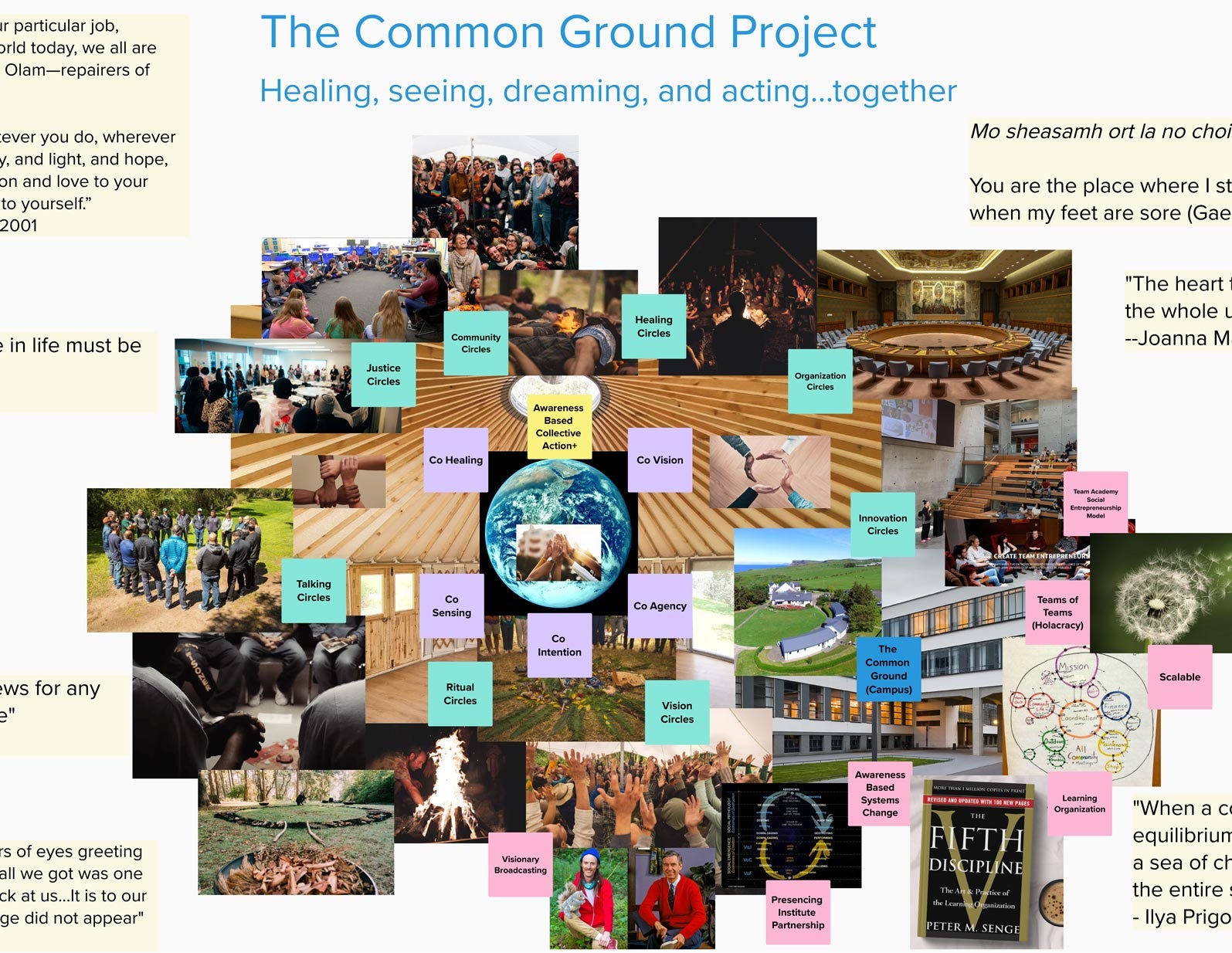
The title has evolved to The Alliance for Common Ground. I’m in the initial stages and conversations necessary for launching this project as a non-profit.
In my circles, non-profits are viewed with skepticism. For more information, listen to my TED Talk on the non-profit industrial complex.
But as I look for ways to share the medicine of community singing, or grieving, or visioning – I find that it is trapped in privileged enclaves. To spread it further requires that it be freely offered, or brought to people who don’t ordinarily have access.
This is relatively easy to do for free, but neither I nor my collaborators can afford to work for free. We’re in capitalism too.
A non-profit is just a story. But it is a story that qualifies for grants. A story that gives us access to incarcerated people, and others who we cannot reach as private individuals. A story that can, just maybe, shepherd ancient medicine into the halls of modernity.
We are searching for board members, sponsors, and partners. If you know anyone who might be interested, let us know (you can reply to this email to reach me).
You can follow the project in our new newsletter.
And if you’re near Olympia, you can attend our next grief ritual on April 18.
Grief permeates life and grieving can take many forms, but grief can never be outrun or simply thought away, transcended or meditated into nonexistence. Necessary grief when shunned or unattended can easily hide for years, even generations, in the skeletal structure of the family collective psyche. Like light, matter, sound, and energy, grief will eventually manifest even among those in the future who did not consciously experience the loss.
So, best to grieve when it’s time, to save the world a lot of war and trouble.
—Martín Prechtel
The Standard Rainbow Hour is a reader-supported publication. To receive new posts and support my work, consider becoming a free or paid subscriber.
 Evan Wagoner-Lynch