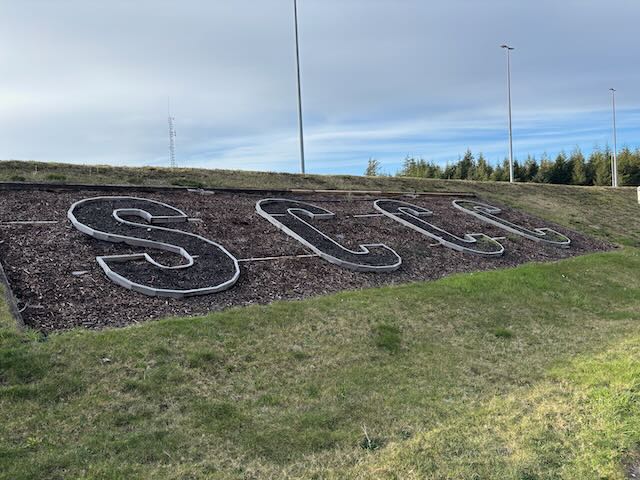
It is in between classes at Stafford Creek prison that I receive a message about a crisis in a community I am a part of. I am walking in a sad post-industrial lot, by dormant toxic waste ponds, enjoying what beauty is present. For Aberdeen, like much of Washington, has beautiful bones. A sinewy estuary, rolling hills, mountains in the distance. Carpets of green trees on hillsides. Look around the human ugliness, and you find beauty.
The message details the latest in a series of ruptures and crises surrounding a man I know. This one is bracing—an accusation that he has recently harmed a vulnerable person.
I’ve been in circle with him, a circle of men, trying to support him as we try to support the greater community. A man who caused terrible harm in the past. And who, himself, was harmed even farther back. Now the specter looms—Has he done it again?
I’m left to chew on this new revelation as I walk back to a car with Evergreen State College livery, to join my supervisor as we drive back to the prison. Through the strange, foreboding little road in the woods. The crest of the hill. The concrete signage. The water tower like a castle turret. The shark’s teeth of razor wire. The stern facade.
The prickly, wary vibe of the corrections officers. We, ever so cheery. They, not convinced.
Through the gates, just like a movie. Jarring buzzers and alarms, fences, cages. And then we enter the campus of the prison. Always that bizarre, transgressive feeling of strolling into a prison.
And then that incongruous sight, that breath of fresh air. Gardens everywhere. Bee hives. A fish pond. Dogs in the dog run, their incarcerated minders in special vests.
Within minutes I am in the education and religion building (an interesting combo), and our students walk in. Uniform in their prison khakis, but each face different. Some tattooed, some blank, some smiling, some brown, some light, some white-haired and aging, others young and vital.
I’m still digesting what I’ve heard about this man I know, who did something so serious that he was put in a place like this for a spell. I’m thinking this as a man I don’t know sits next to me, in prison khaki, and extends a fist for a bump.
There’s a linger of wariness in me. Who is this man? Is he safe? Can I trust him?
I extend my fist. That contact of human skin to human skin. Under strict prison rules, one of the only approved ways we can touch.
As class unfolds we spend many hours together. Sometimes, the formality of teacher and student. A question about the homework, the schedule. But at Evergreen, we offer more questions than answers. The students venture their thoughts into the center. Many will tell us, there is no other context in their lives where they get to do that. To have an opinion, to not be sure, to make a guess, a mistake.
In this way we get to know each other.
I take a risk in the class. I invite us to sing together. These people have little reason to trust me. They’re just meeting me. And to my delight most of them give it a try. I hear among us some gorgeous voices, perhaps church-honed. Others more tentative. But what matters is not how they’re singing, but that they’re singing.
The beauty escalates. Later I take another risk. I teach a little seminar on dialogue. I facilitate (a bit wobbily), an active listening practice. The students let me stumble, they give it a shot.
There’s an opportunity here to do something a little outrageous. I have an offramp, we can just talk about what we’ve learned. But the professor has given me the greenlight to wayfind. I take us down a new path. Something quite difficult, something few people get on the first try. Can we have a group dialogue, a talking circle?
With a trickster flourish, I place a small piece of cedar in the center of the room. Why did I do that, I ask them.
To bring in nature, they say.
As a focal point.
Because cedar is healing.
I smile, thrilled that they’re on the scent.
Then I pose the prompt: Why do we use dialogue in our classroom?
At first, the students default to what we all do, which is share a succession of opinions. I remind them of the dialogue fundamental, to “respect,” which in this context, means to paraphrase what the last person says before speaking your piece.
That’s all it takes. My heart swells as the students start passing the dialogue around the room. It’s not a debate, not an airing of opinions. A singular dialogue is building. Some threads, from the notes I scribbled down:
Dialogue propels the next thing…like water to seed….allows thoughts to grow…a crucible…that human thing, of listening and speaking…a community of different interpretations…community—communicate…
And then the mic drop line, the group’s response to the question, why do we use dialogue?
We’re building when we’re talking.
I weep writing this, and thinking of that moment. One of the main texts in the field of dialogue has the subtitle, “The art of thinking together” (Dialogue, William Isaacs).
In that room my heart thrums in my chest, a smile melts my face. I beam at these students, in their prison khaki. I am so proud of them. I see their shy smiles shining back.
Human beauty in this ugly place.
#
That other thing, that hard thing outside (for the prison is inside).
It’s a mess, it’s live, it’s happening right now.
The split screen of it threatens to rend me in two:
Inside, I sit with people who have been incarcerated, some of them for longer than I have been alive. They are in there for all manner of reasons. I could take to the TED stage and talk about the cyclone of systems that funnel so many of them from cradle to cage. And yes, among them are those who have caused terrible harm in our communities. Scary and terrible tales.
I never ask them what they did.
I am the one who meets them where they are at. Which is at an improbable place. A classroom in a prison. Like salmon swimming up a waterfall, so few of them make it to these life-giving waters.
When they get to us we offer them an education. Our alumni tell us that education helps to liberate their minds. But there’s something else at work in our program. A graduate of our environmental prison education program, now a free woman with a master’s degree from Evergreen, recently told me that in our classroom she found her humanity. You treated us like people, she said.
What a gift, what a gift to do that for them. To be medicine for another simply by meeting them, person to person. No doctorate is needed for what I do. We could (and should) be doing this for one another.
It can be exhausting work to shuttle out to that prison on the coast, to bang your head against dueling bureaucracies. There is a cost to the body of being in that place, the trauma is in the air.
But my heart is filled, my spirit soars, my soul hums with approval, when I am with my students. Yes, there’s grief, but that just means we are in the waterfall of life, truly living, being with another, contending with ugliness and beauty, wounding and healing, violence and growth…together.
#
Outside I am witnessing a paroxysm of rupture, a community explosion, and the cry: Send him back to prison.
And despite the certainty of the voices shouting the loudest, condemning him, I am cautious with my judgment. Because I know we can change and grow. I know that we might see a monster when there’s just a wounded person who has never had his light reflected back to him by loving eyes.
I know that the complexity of human interactions often bang up against our statutes (fist bumps or handshakes ONLY), and that it always does violence to reduce the universe of a person to a single word.
I know that we lash out when we are scared, that we banish that which we cannot face in ourselves. Martin Luther King, Jr. liked to say, You can murder a murderer, but you can’t murder murder.
We grasp for cages and the violence of the state for that which we cannot handle ourselves. When we call 9-11 what we want is help, what we want is to be rescued.
But the truth is the systems have not kept us safe. The only true safety is us. And indeed, it is the systems that tear us apart, that are the breeding ground of unsafety.
It’s a terrible bind we’re in. Like eagles fighting, we are in a death spiral, our claws locked, hurtling toward earth.
As I said, it threatens to tear me apart. Our paltry movements toward our collective liberation, versus the might of the state, the cold calculus of our economies.
Our prayer for peace, for the thriving of all of us, versus the lesser angels of our nature, our old tribal ghosts of ostracization, of us versus them.
And in it all we are children, orphaned, not an elder in sight. Children in our Corrections Officer uniform, in our prison khaki, in the various costumes we wear in our own communities.
Run far and fast from anyone who claims to know the way.
In the in between place where I live (and shh, you live too), all I can say is I don’t know the way. We need help in this. Not from the authorities, but from each other. From our ancestors, from the earth, from spirit, from whatever wise guides we can find.
I’ll paraphrase Jay Thomas, our 2026 commencement speaker for the Evergreen Prison Education program: I am praying, dreaming, and scheming for a world built for everyone.
It matters less to me whether we get there, than whether we walk that way together.


[…] Split Screen; On rupture and Repair […]
LikeLike