This piece was first posted on my Patreon this summer.
Here’s a little update from my research trip to the Tamera ecovillage in Portugal. This visit was funded by you, and a scholarship from Evergreen State College. Thank you.
We gathered in a circular patio under a sun awning. A mild spring day in Portugal, but the sun beat down on us. It was sweltering under the awning.
A preternaturally handsome man with a mane of salt and pepper hair and a quiet BBC radio voice suggested we move a few feet away.
I suspect it might be cooler, he offered. I wonder why?
We moved out from under the plastic awning to a beautiful living shade, a tree that had been trained to form a living sunshade over a circular seating area. It was at least 10 degrees cooler. The sun, striking the leaves above, shone green.
Our host explained that the natural sunshade, made of plants, was a natural evaporative cooler. The plastic shade, on the other hand, trapped heat and was made of fossil fuels.
This lesson reverberated time and time again at Tamera.
On another day, Jan, a slight German man with a monk-like mien gave us a guided tour of Tamera’s water retention systems.
He started by asking us to see and think like water, as we silently walked down sunbaked paths and past gardens and trees.
He guided us to a cool green glade that was notably more humid than the arid surrounds. Beside us was one of fourteen water retention ponds that the community has built.
He described how an international expert on water retention came to Tamera in the early days and taught them a core tenet: The best water storage is in the earth herself. So they shifted from ponds to terraces and swales. Jan pointed to the ground we were sitting on, actually a terrace.
He told us that landscapes that retain water can actually support local weather systems: Mist, and rain. Rivers fed not by seasonal rain and snow melt but by local springs. It sounded like fantasy to me but Tamera’s 340 acres were undeniably greener than the surrounding denuded and overgrazed countryside. A green Eden in the dry south of Portugal.
Heike, a German woman in her 60s, her skin browned and wrinkled by years of sun and wind, sat before us to talk about communication with animals. As a peace village, Tamera is committed to peace amongst humans and between humans and nature.
Heike told us of a wild boar invasion, caused by the clearcut of a neighboring grove of invasive eucalyptus. She told us how the boar came in great numbers and laid waste to the vast gardens of Tamera. How the residents and volunteers wept at the sight of the destruction.
As a peace village, Tamera faced a conundrum: How to protect the gardens while maintaining peaceful relations with their boar neighbors. So they put out a call for an animal communicator.
Heike, a student of an animal communication expert, came to the rescue. She taught the gardeners to see and think like boar, even to smell (“humans smell awful to the boar.”)
She determined that the boar were ravaging the irrigation system because snails were drawn to the pipes.
She prayed and spoke to the boar in her mind’s eye. She told them what they could eat, and asked them to spare certain gardens.
After a while, the gardeners were collaborating with the boar, employing them as living plows. Most of the gardens remain unfenced, and undisturbed.
Even to this day, when visitors come to Tamera, the animal communicators let the boar know, so as not to startle them.
On the learning campus, the workshop participants were astounded when little families of boar raced by on missions known only to them. Little piglets with fawn stripes sprinting on short legs. Mommas taking up the rear, pausing to eye the humans. Then trotting off.
I’d always heard that wild boar are dangerous, but at Tamera they maintain a peace with the humans born of mutual respect.
One breezy afternoon I walked a path with Heiko, a participant from Germany. We were trying to find the way to a fire road that undulated up into the brown hills. We’d been encouraged to explore but to steer clear of dwellings.
A building was ahead of us, and next to it, four women sat at a picnic table.
A woman stood up to meet us and I had the sense of a wild boar momma interceding with us.
She smiled and told us that this was the school and asked us where we were headed. She pointed us another way to the fire road, explaining that at Tamera, they are protective of their children.
#
The grief expert Francis Weller speaks of a grief we all share: What we expected and did not receive. And an example he shares—That upon our birth, we all expected 40 pairs of eyes to be staring back at us. In the modern world, of course, it is rarely so.
And so tears came to my eyes when I looked at a photo of a birth at Tamera. I saw a happy couple in an inflatable pool, a newborn in their arms. Around the new family, a ring of community members smiled down at them. The whole tableaux was painted In bright Portugal light, for the birth occurred outdoors, under a white tent.
The very same couple sat before me and I told them that it looked like heaven on earth.
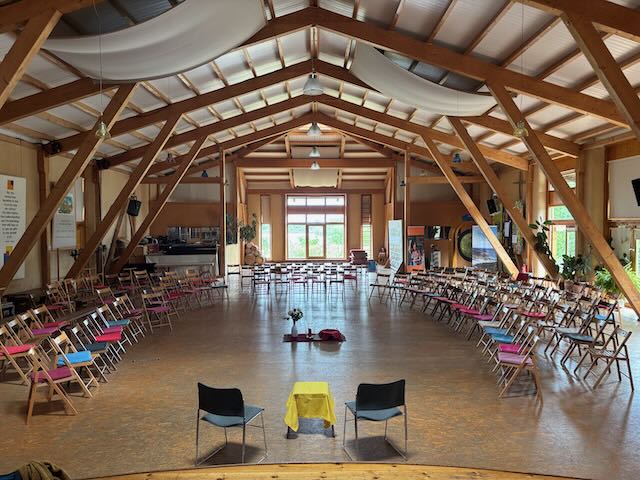
They shared that babies are born all different ways at Tamera. Some people opted for the privacy of an intimate family group. Others called in close friends and neighbors. One mother asked the entire community for support. Eighty people attended that birth in the Aula, the main hall of Tamera.
Eighty pairs of eyes. Not bad.
Perhaps the most striking testament to the community experiment underway at Tamera was the children themselves. We saw them everywhere, tan from the everpresent sun, laughing, playing. They seemed remarkably secure, at ease, confident.
A few days into our introductory week the community held a Beltane festival to mark May Day. As part of Beltane, we were invited to leap over a bonfire.
The participants and guests eyed the bonfire warily. It was the children who led the way, some of them jumping the fire five or ten times throughout the evening.
A 12-year-old girl reassured me in English: It’s easy, just empty your pockets and run fast.
Later I saw some Tamera children accompanying a hesitant guest in a sprint over the fire.
Perhaps what I read as confidence was simply belonging. These children walk tall on ground that they were born on, in a land they are in relationship with. Around them, forty pairs of known eyes, and perhaps 40 strangers. But what’s a stranger to a child who knows they belong? A potential friend. Perhaps a person in need of a little encouragement.
Take a leap with me, they say.
###


Hi Evan! Grateful for your writing, as usual! Both pieces you sent recently. They offer hope! I am wondering if you have given thought to integration of these concepts into an existing community, like Orcas, for example? What would housing look like here that would support these tender, nurturing concepts you recognize as a way forward? You lived at April’s Grove. How would you re-envision it? And nobody gives much attention to the Longhouse, except to say we are so lucky we have this building for the low-income elderly. They say this over and over again, never acknowledging the lived experiences of stigma, isolation, much illness, and loneliness there. And a whole lot of street noise. A place you are lucky to die in. I have heard some patronizing suggestions: have the school kids organize a game night in the Longhouse community room. I suppose that would make some people happy, but it feels akin to what the Lions Club does at Christmas. They hang a plastic bag of puzzles, pencils, bells, candy and an orange on our hallway doors, as if we are children that need a cheap distraction and a treat. The members of the Lions Club really enjoy their day when they meet to gather all these trinkets together for the “benefit” of the elderly poor, with their seasonal charity. Mainly, these efforts prove there is good intention, but a kind of Plato’s cave vision. So, what do you see? You have given me the idea to work on my own vision. And I would love to hear yours. I feel like this is a missing step in our evolving. We need a bridge. It is almost as if we know there is a huge, high wall there, and how to climb over it? The wall, unaddressed, of how much the poor deserve of public funds. The wall of architects and construction companies, who offer us over and over again the same plans and designs, never looking with new eyes at “efficiency” and this priority to design around our automobiles. Instead of places where the earth and the animals and the night sky can be nurtured, too.
So, those are my thoughts. You have moved me a little closer to feeling and believing in a world that is a welcoming home for all the beings, or as the Salish original humans know, all the people. The tree people, the rock people, the cloud people, the fish people, you and me.
Love, Pegeen ________________________________
LikeLike
[…] conducted a research trip to the Basque region of Spain and attended a workshop intensive at the Tamera eco-village in […]
LikeLike