Anticipation builds as I pull into the familiar sterile parking lot of Stafford Creek Correctional Center. I step out of my car and into the strange incongruity of the natural setting, concrete, and razor wire. My fellow faculty from the Evergreen Prison Education Program (EPEP) arrive and we don our Hogwarts robes and head inside.
A flurry of activity in E-Building, normally the site of education and religious worship. Today, we arrange stacks of graduation gowns. For the first time, the Evergreen and Grays Harbor College faculty in the same room, fretting, abuzz.
Then the guys arrive, and we help them don their robes. We adjust stoles and hats, tentative to offer help (institutional rules against touch loom large). Soon there are over 100 incarcerated students in robes in the E-Building. Most are in the blue of Grays Harbor. But at the front of the line, our little cadre, our 14 graduates, smiling and joking, in Geoduck green.
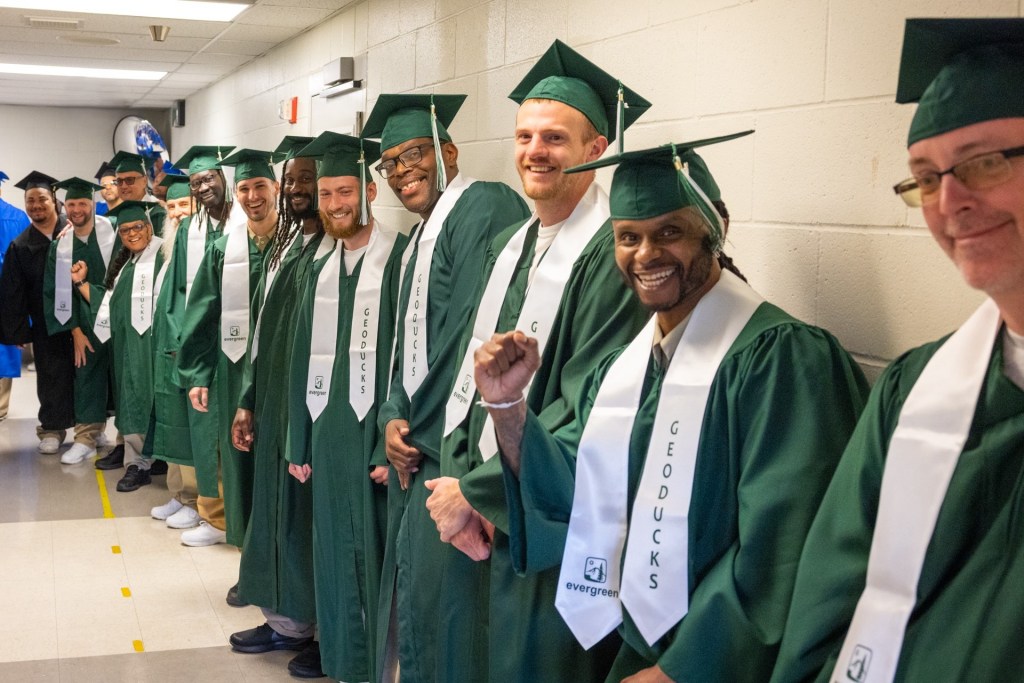
Then we process to the visitor’s center, the colorful robes violating all manner of prison dress codes. I sense in everyone who sees us, resident and staff alike, a hesitant distance, maybe even reverence.
We near the visitor’s center from a perspective I rarely see, that of the insider. The center is situated at the barrier fence, straddling inside and out. I usually enter from the outside. Just visiting.
We walk into a linoleum-lined hallway, a back entrance. Some nervous joking amongst the students. Are you gonna get a pat down, too, one of them asks. I look ahead and see that a corrections officer is frisking every graduate as they pass. I follow my faculty and we blithely walk by, exempt. One of the many ways in which we are different.
We enter a liminal space, where inside and outside meet. Strange clear tables, warnings posted on the walls, cameras and mirrors everywhere. I am reminded of the famous building in the demilitarized zone of the Koreas, where two countries technically still at war can meet in truce.
A remarkable truce, then, in the visitor’s center at Stafford Creek. One hundred graduates, robes covering their prison uniforms. To one side, a paltry cluster of family and friends (perhaps one for every six graduates). I sit in a little cluster of faculty. Official visitors sit at the head of the room, college and Department of Corrections heavyweights, local elected officials. The smallest cluster is in the corner, a handful of incarcerated teaching assistants in their prison drab.
I am ever mindful too, of the staff, hovering, most of them stone-faced, taking us all in. But among them, a few smile tentatively. At peak moments, I clock that some of them clap along with the rest of us.
The program begins. The first speaker is one of the top officials at the prison, an assistant superintendent, and I am surprised that she nearly chokes up with emotion. She describes being out back and watching the graduates file in. Seeing you touched my heart, she tells them.
I take in the graduates. There is a uniformity to their rows of chairs, their matching robes, and underneath, the hint of khaki. But each face is different. I watch some faces remain slack and unreadable the entire time, through applause, through jokes at the lectern, through receiving the praise of their fellows. I watch other faces tentatively opening, a shy smile, wary of the attention. And I watch other faces incandesce in moments of joy that seem unwise, too close to the sun, for soon the ceremony will end and the friends, family, and faculty will leave.
My heart aches for all of them.
There’s another feeling in the room.
I feel it so strongly when I see the student speakers take the lectern and address us. One GED graduate, a Mexican national, speaks in halting, newly-learned English, to offer his gratitude and his hope for the future. I marvel at his courage, speaking before this crowded room in an adopted tongue. And I can feel his heart, his earnest desire to get through to us:
Thank you for believing in me.
I am changing.
My heart thrums. A seasoned Grays Harbor faculty next to me leans in and mutters, I feel like a proud father.
Yeah, me too, I respond as we applaud.
Then W. takes the stage. Or rather, W. transforms the dour lectern and the industrial carpet into a stage by the sheer force of his presence. He nabs the mic from the stand and strolls easefully around the front of the room. He speaks seemingly off the cuff, riffing on the importance of education in prison, on growth, on human potential. I feel a bipolarity in the room as three quarters of us laugh and clap and enjoy the ride, while the DOC staff track him with their eyes, their faces impassive.
I picture W. on stages outside, at high-powered conferences, under the bright lights of a premiere venue, tracked by the eyes of HD video cameras, piped into your living room.
He is toying with us, playfully mentioning that he has been told to keep it brief. Stretching the space to say what he wants to say. A dangerous move, perhaps, a flourish he may pay for. And then he lands it with a kiss, a memorable line, a poem for an audience of concrete, defiant, and very alive:
Creative imagination is freedom from stagnation.
Three quarters of us applaud and cheer.
Evergreen closes out the ceremony. It is time for our fourteen to graduate. Evergreen’s President invokes hope, and touches upon the Evergreen’s nontraditional ethos: student-led learning, across disciplines, across significant difference. EPEP faculty take it further – what does it mean to apply this ethos inside? To ask students to direct their own learning, in this context?
EPEP student J. takes to the lectern amidst applause and cheer. He walks tall in his robes, his bearing almost regal. Just one of those people, a natural leader. On the way, he leans into the audience and hugs an older woman. His mother. It is a beautiful moment. Tears stream down her smiling face.
He arrives beaming at the lectern and says, I don’t know if I was supposed to do that. That’s my mom, y’all.
And three quarters of us cheer.
I know I am not alone in fretting for J. Hugging is not allowed. It’s something he may pay for.
And then J. begins to speak, with the easy force of someone who knows they have rightness on their side.
Education is the only path to our liberation, he declares. A striking statement as the weight of the State presses in on all sides.
I imagine the walls cracking.
J. shares what has blossomed in him, amongst his colleagues in the program. Throughout it, that outrageous drumbeat, that blaspheme in this cage: liberation, liberation, liberation.
I can feel his gravitational pull. The strength of his conviction, the courage in his heart, the dignity in his carriage. Something is brewing in the visitor’s center at Stafford Creek.
There’s a bigness to our little cohort, our band of scholars. They stand chin up before a storm of steel and stone, before systems that grind soft bodies to dust. To walk with them, to truly know their stories, is to accompany a friend through the Inferno. No one knows better than they the violence in the basement of our society.
We call them Offenders. We loathe to behold them so we banish them behind high walls. We say they are different. Or more importantly that we are different, that we are Good, we are not like them.
But if we are secure in our goodness why do we fear them so? Is it possible that when we see them we are looking in the mirror? That our hearts quiver with the horror movie recognition that the monster is inside the house?
That inside these prisons, if we go inside, we meet us?
And what if it is no horror movie, but a documentary about us. About our struggles amidst systems and forces that destroy life. About the ways we lash out in our pain, about our capacity to make terrible, irrevocable mistakes.
Perhaps a nature documentary, where from the eyes of a helicopter we look down at an ecosystem in grave distress. And this creature that walks the earth, this human being, is not exempt from the suffering of the land. That there’s a rightness, a naturalness to our acting out. For our home is sick. And so, rightly, are we.
And so these scholars have stumbled, they have lived out the violence of our world, recipients and agents both.
#
I have a conviction, too. I believe that I am not separate from them.
I can tell you, it stretches the soul to believe this. That my heart bursts with grief when I sit with the truth of this.
There are no monsters, only us.
There are no offenders, only us.
My soul recoils at what we do to each other. The ways we harm, cage, and punish one another. Lost in the delusion of separateness, that we can put one of us inside a box and call the rest of us free.
In the face of destruction it is a wild, outrageous thing to give someone a liberal arts education.
In the context of the prison system this is laid bare.
Why educate a person with a life sentence? So what if they learn and grow?
Why read Utopia, why sing, why think critically?
Would it shock you if I told you that most of the people I encounter inside dream of a better world, too?
Is it possible that they hold a key for all of us?
It is clear to me that for the global crises we face, we will need all hands on deck.
It is clear to me that whether we realize it in time, or not, circumstances will make it clear that we are in the same precarious little boat.
We are in the same precarious little boat.
#
In that severe room, surrounded by those impassive walls, that shatterproof glass, J. is taking us to his conclusion, his eyes gleaming, his face smiling.
We are dreaming and scheming, he says, for what a world built for everyone actually looks like.
We jump to our feet, cheering, clapping.
My heart soars in my chest. I look to the ceiling, to the improbable sculpture of flying birds. I look to the back of the room and watch a corrections officer clapping, his face illuminated by a broad smile.
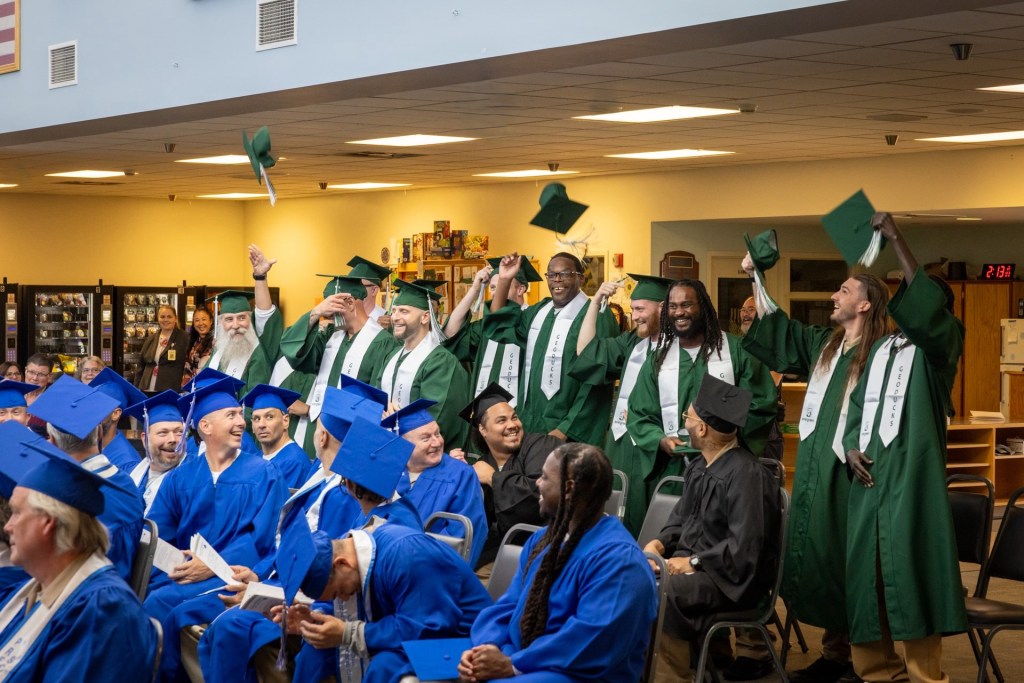
As their names are read aloud, each of our scholars walks to the front to receive their congratulations.
That’s all of our students, one of our faculty announces.
And then my advisor, Eirik, pipes in, Actually we have one more.
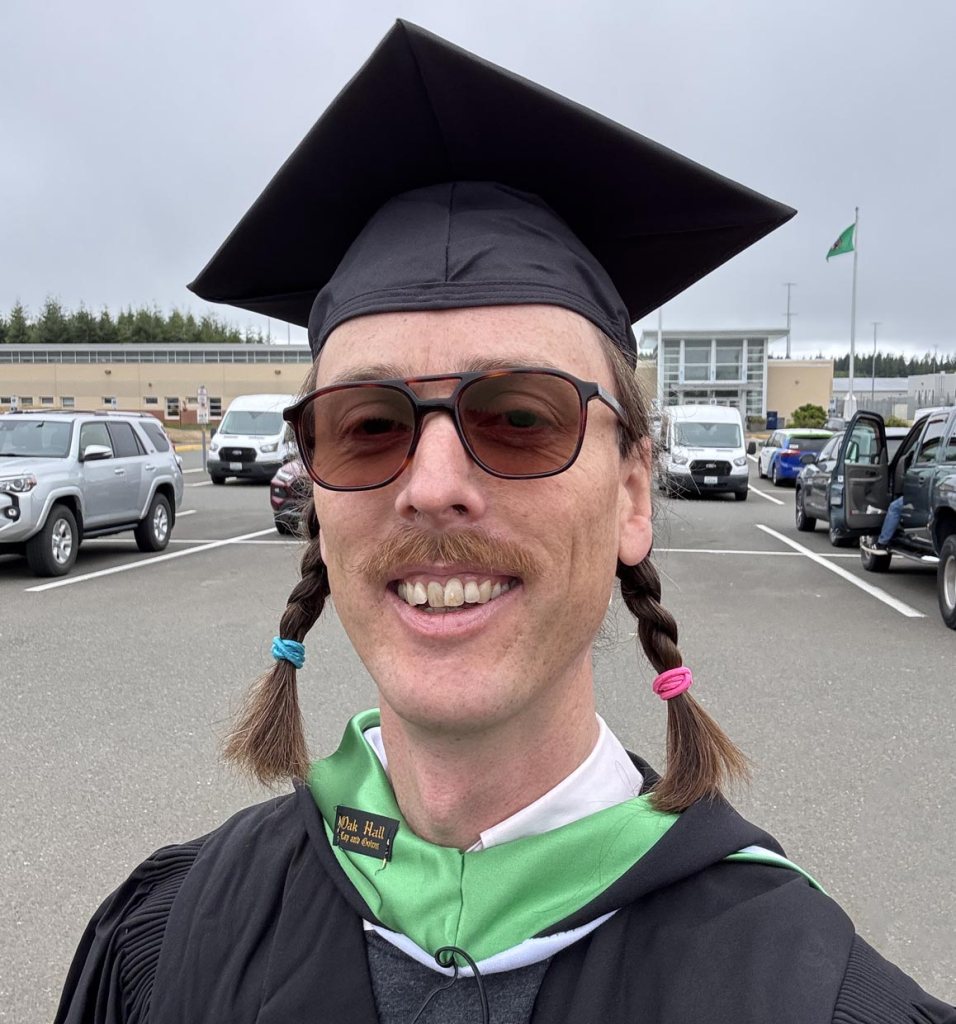
And I rise and walk to the front, to hear my name called, to receive my congratulations.
I have been cheering for them and now they cheer for me. I turn to the scholars in their robes, and I mime a heart to them, my hands opening, the heart bursting.
As I sit down I hear Eirik say, Evan is from the Olympia campus but he chose to graduate here.
And I sit with the truth of that. There’s nowhere I’d rather be. No one I’d rather graduate with.
I am proud like a father. My heart is full.
I am happy to walk alongside these incarcerated people. I am happy to accompany.
#
Afterwards we mill in a strange alternate reality: a celebration in a prison.
I watch one of our students, normally freighted by the weight of his predicament, alight as he poses for innumerable photos with every conceivable combination of our faculty.
A graduate who I’ve never met, from Grays Harbor, approaches me. He extends his hand. Congratulations, he says.
Congratulations, I volley back.
We’ll get there, he says, smiling.
#
Walking out of the prison, at the gate, I hear one of our distinguished guests say to a colleague, We get to leave.
###


[…] skipped the campus graduation and instead walked with my incarcerated colleagues at Stafford Creek Correctional Center, in the first ever graduation ceremony of the Evergreen Prison Education Program. This will remain […]
LikeLike